


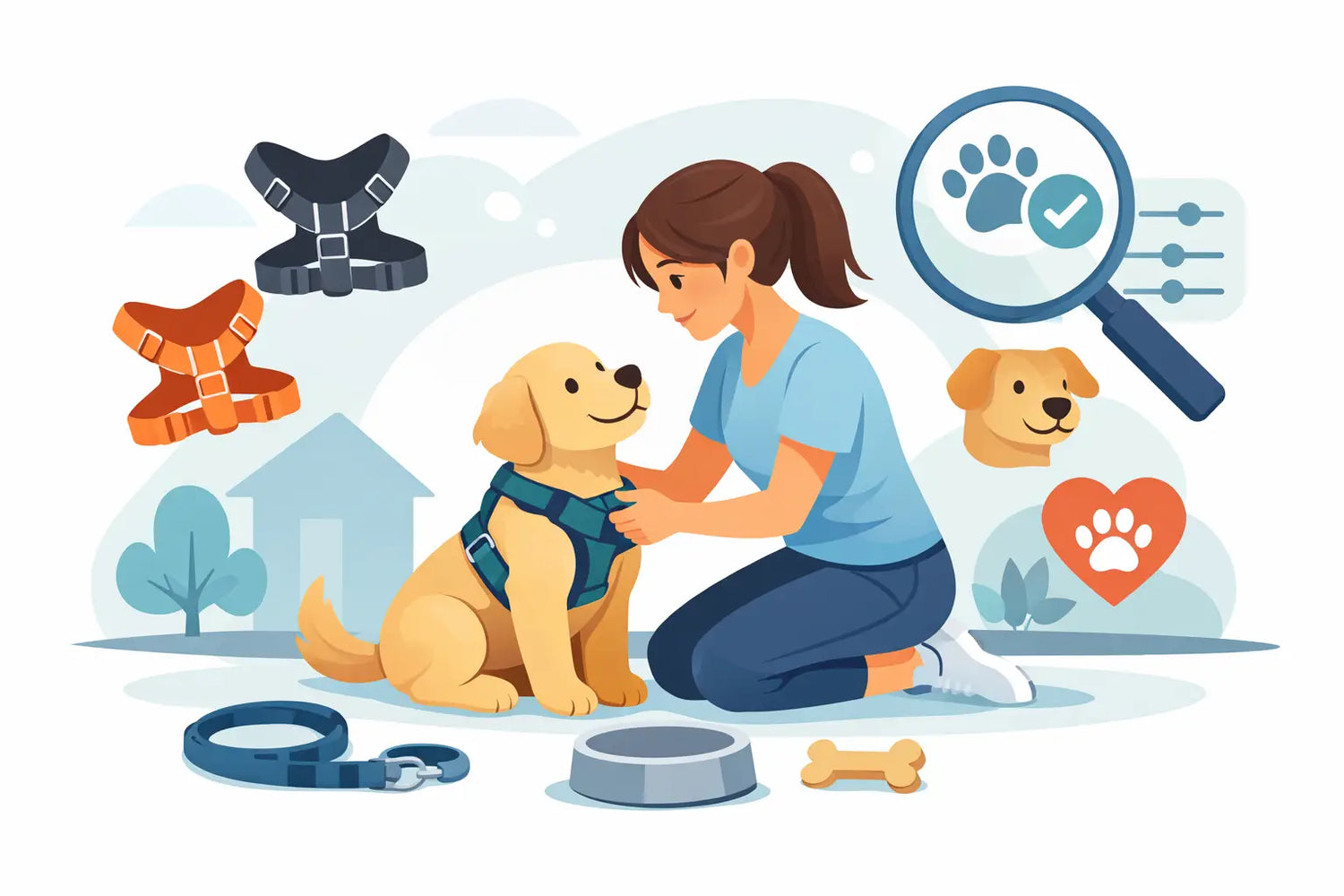
The first time you clip a harness onto a wriggly puppy, you realise very quickly that fit is everything. Too loose and your little one can back out of it in seconds. Too stiff and those first happy walkies feel more like a wrestling match than a lovely routine. If you are wondering how to choose a puppy harness, the sweet spot is always the same - comfort, security and a shape that suits your puppy’s size, coat and stage of growth.
A good puppy harness should feel gentle rather than bulky. Puppies are still learning how to move on a lead, how to explore the world and how to stay settled around new sounds, scents and people. The right harness supports that learning without rubbing, pinching or making them feel restricted. For small breeds especially, a lightweight, well-fitted harness usually feels far kinder than anything heavy or overly structured.
Why choosing the right puppy harness matters
Puppies are not just miniature adult dogs. Their bodies change quickly, their confidence develops week by week and their skin can be more delicate than many owners expect. That means a harness that looks adorable in a photo is not necessarily the one that will feel best after ten minutes outside.
A well-chosen harness helps distribute pressure more evenly across the chest and shoulders rather than concentrating it around the neck. That can be especially helpful for tiny dogs and young puppies who are still learning lead manners. It also gives you a little more control in busy spaces without making every outing feel fussy.
There is a style element too, of course. For many pet parents, walkies are part of the daily rhythm and there is real joy in choosing pieces that feel polished, coordinated and a little bit special. The best harnesses manage both jobs beautifully - they are practical enough for everyday wear and lovely enough to feel like part of your puppy’s wardrobe.
How to choose a puppy harness for the best fit
Start with size before print, colour or matching accessories. Even the prettiest harness will be wrong if it does not sit properly.
The key measurements are usually the chest and the neck, although chest size tends to matter most. Use a soft tape measure around the widest part of your puppy’s chest, just behind the front legs. Measure the lower neck too, where the harness will sit, not where a collar would sit higher up. If your puppy is especially fluffy, measure snugly without compressing the coat too much.
Always compare those numbers with the brand’s size guide rather than guessing based on breed. A toy cockapoo puppy, a miniature dachshund puppy and a pomeranian puppy can all look similar in size at a glance while having very different proportions. That is where many fit issues begin.
Adjustability matters as much as the starting size. Puppies grow at a surprising pace, so a harness with room to adjust around the chest can give you a better fit for longer. That said, do not buy something massively oversized in the hope that they will grow into it. A puppy harness should fit the dog you have now, not the one you expect in three months.
A simple fit check helps. You should be able to slide two fingers between the harness and your puppy’s body, but no more than that. If it shifts dramatically from side to side, gapes at the shoulders or rides up into the throat, it is not the right fit.
Which puppy harness shape is best?
There is no single perfect style for every puppy because build, breed and walking confidence all play a part. Still, a few general rules make shopping much easier.
Soft harnesses
Soft harnesses are often a lovely option for small breed puppies. They tend to be lightweight, cosy and less intimidating for dogs who are new to dressing up for walkies. A soft, breathable design can work especially well for tiny frames because it feels secure without the hard edges of more technical styles.
The trade-off is that soft harnesses need to fit especially well. If they are too loose, they can twist. If they are too padded, they may feel warm in milder weather or bulky on very petite dogs.
H-style harnesses
An H-style harness usually has straps around the neck and chest connected by a piece along the front and back. These can be very adjustable and are a good choice for puppies with tricky proportions. Because there is less fabric, they can feel lighter and cooler.
The downside is that some puppies find thinner straps less cosy, and if the design is not well made, pressure points can become more noticeable.
Step-in harnesses
Step-in harnesses can be helpful for puppies who dislike anything going over their head. You place the front paws into the openings and fasten it over the back. For some owners, this makes getting ready for walkies much quicker.
However, not every step-in shape suits every body. On a very wriggly puppy, getting the paws placed correctly can still be a challenge, and a poor fit can make escaping easier.
Fabric, fastenings and comfort details
Once shape and size are sorted, look closely at materials. Soft mesh, smooth lining and lightweight fabrics tend to suit puppies well because they are breathable and less likely to irritate delicate skin. Rough seams, stiff edging and scratchy labels are all worth avoiding.
Check the fastenings too. You want something secure, but not fiddly enough to turn every outing into a production. Sturdy clips and adjustable straps usually make life easier. For a growing puppy, the difference between a lovely harness and one that ends up in a drawer is often in those small everyday details.
If your puppy has a longer coat, consider whether the harness is likely to mat the fur under the chest or behind the legs. If they are very fine-coated, look for a softer finish that will not rub on bare patches of skin. It depends a little on breed, coat type and how long the harness will be worn each day.
Safety points many owners miss
Security matters just as much as comfort. A puppy can be surprisingly quick when startled, so the harness should feel snug and dependable before you head anywhere busy.
Check that the D-ring for lead attachment is firmly stitched and positioned sensibly on the back. Make sure the harness does not interfere with natural movement through the shoulders. Watch your puppy walk indoors wearing it first. If the gait looks awkward or shortened, the cut may not be right.
It is also wise to think about visibility. If you are out early in the morning or later in the evening, lighter colours or reflective details can be useful. Stylish and practical can happily coexist, and for many dog owners that is exactly the goal.
Style still matters - and that is perfectly fine
For many of us, buying for our dogs is not just about utility. Pets are more than just companions - they are family. If your puppy is going to wear a harness every day, it makes sense to choose one that feels like them and fits beautifully into your routine.
Coordinated accessories can make everyday walks feel a touch more put together, particularly if you love a polished look. A matching lead, bag holder or little seasonal extra can turn a practical purchase into something joyful. The key is to treat style as the finishing touch, not the starting point. Fit first, then fashion.
This is where a thoughtfully designed collection really shines. Brands such as Paw Wraps appeal to owners who want that balance of comfort and boutique charm, especially for smaller dogs who deserve practical pieces that still look special.
When to size up, replace or reassess
A puppy harness is not usually a one-and-done purchase. Growth spurts happen quickly, and a harness that fitted perfectly a few weeks ago may suddenly look tighter around the chest or sit differently at the shoulders.
Check the fit regularly, particularly during the first year. Signs it is time to reassess include rubbing under the front legs, reluctance to walk, difficulty fastening it, or visible marks on the coat or skin after wear. Sometimes the harness itself is fine but your puppy has simply outgrown that stage.
You may also find that what works for early lead training is not your long-term favourite. Some puppies start best in a very soft, simple style and later move into a more structured shape once they are bigger and more confident. That is normal.
A simple way to make the right choice
If you feel overwhelmed by options, keep it straightforward. Measure carefully, prioritise a secure fit, choose soft and lightweight materials, and pick a shape that suits your puppy’s body rather than following trends. Then, if it also happens to look adorable and coordinates beautifully with the rest of your walkies kit, that is a very happy bonus.
The nicest puppy harness is the one your little dog barely notices wearing - because they are too busy trotting along, tail wagging, ready for the next small adventure.


Leave a comment
This site is protected by hCaptcha and the hCaptcha Privacy Policy and Terms of Service apply.